Does anyone know how to use pointers, anymore?
Inflammatory article about a serious topic. How did this happen? Why are we wasting cycles on this? How did the compiler even allow this to happen?
What is this about
So, I have been wanting to just document some of the reverse engineering work that has been done by fellow soulsmodders, and myself. For one, so that we have a bit more documentation on the inner workings on the Dantelion 2 engine, the engine that the souls games are on, and a lot of the Armored Core games, as well. Kings Field? IDK. Maybe, I haven't looked. I also wanted to expand ErdTools, a tool for debugging the game as it runs, so that it could read the player inventory,as well as delete items and move them between inventories, so, I had to go and track down the code that handles all of this. I also need this code for some future projects, but, for now, I figured it would be cool to get started documenting things by documenting how the player inventory works.
I found something interesting, and looking into it just a bit deeper, it seemed to be an issue in a lot of places.
The offending code
I don't really know how terrible this is, but, it can't be great on a CPU that relies on branch prediction for speed. Here is the post from Twitter that I originally posted.
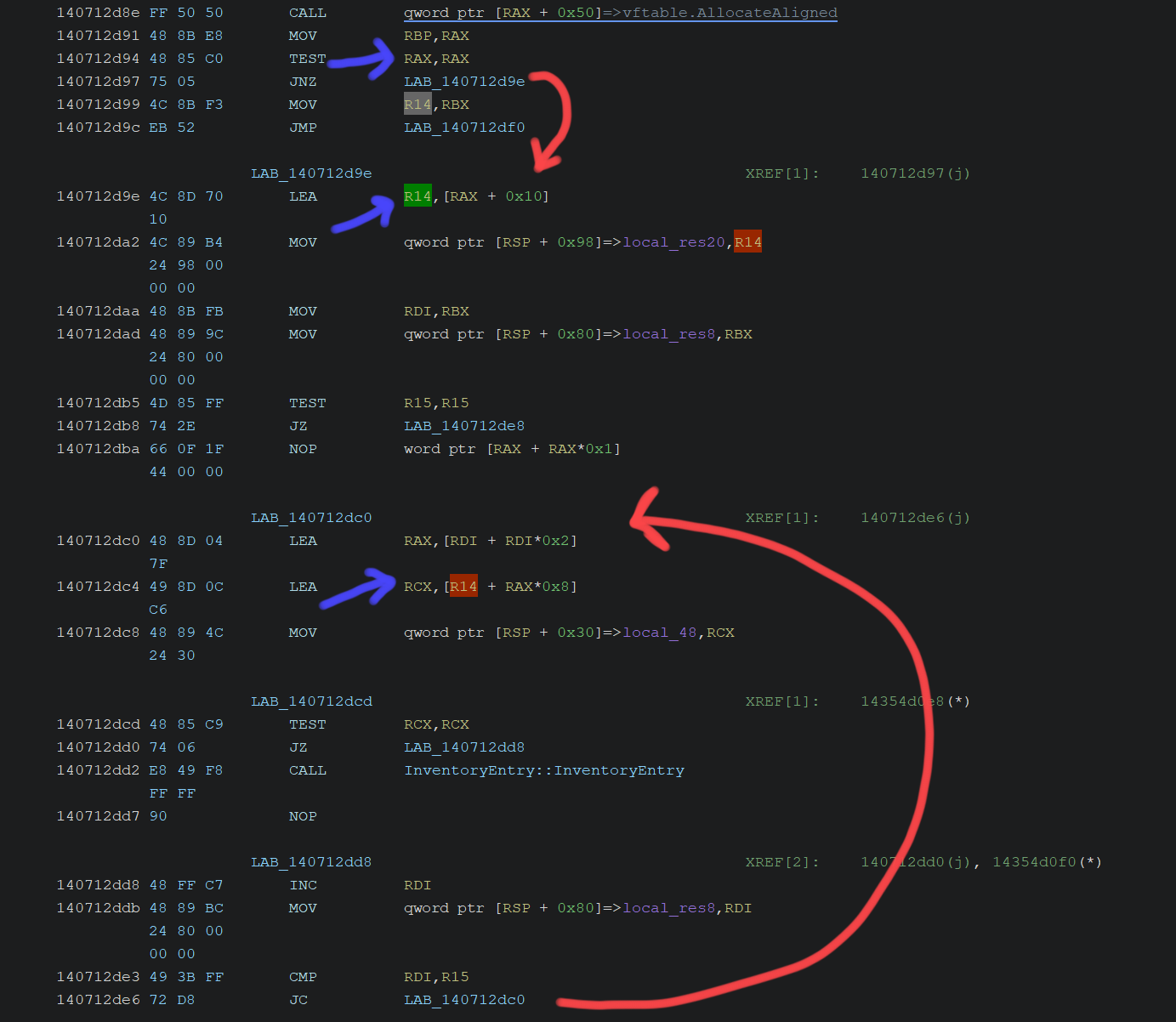
This picture is similar to the picture with the original question, but with more context. I have drawn arrows for the important jumps in red, and I also pointed out the allocation we are initializing in blue. I also highlighted R14, which is where the base of our inventory resides, for our indexing math. At the top, we start by calling AllocateAligned on our main heap allocator (Of which the setup is omitted, just trust me, bro). After the call we have our pointer returned in RAX, as this is the convention in x86. We then test RAX against itself. The TEST mnemonic is an instruction that will "bitwise and" it's two operands together, and set various flag registers, one of which is ZF, or Zero Flag. This flag is 1, or true, if the resulting value is 0. This can only happen with a value of zero in both operands, so this make a very efficient way of testing a pointer for null. We then move on to a JNZ, which is our first jump. This instruction will look at ZF and jump if it's set to 1. If we don't jump here, we fall to an unconditional jump that exits the function. This is good, and what we should expect from a C++ program like this.
What comes after is a bit peculiar, because, I know compilers are smarter than this. That first test has us jump and avoid exiting the function, if we get a non-null pointer back. This part of the function immediately adds 0x10, which is 16 bytes, to the pointer value with a LEA, or Load Effective Address instruction. This instruction loads the address of something into a register, and is optimized for pointer math, so, is often used for traversing structures, etc. This is where the start of the actual array that is going to be initialized and used for the inventory. We store this in R14.
We keep going, do some indexing math, do a check, call a function, and then we check to see if we have reached the last item in the array, which is in R15, and the current item index in RDI. We then jump right back to where we are doing pointer math with R14 and friends. You may ask, where is the issue? Well, I kinda skipped over the check we do after the index math, because, that is the issue. Remember, TEST is going to and it's operands together and set the ZF flag to one ONLY IF the number is ZERO, as, bitwise anding any other number with itself will result in, well, that number.
There are two instructions here, but in the end we take the value that is in R14 and add RAX * 0x8 to it, and then store that pointer value in RCX. Since the only operations we have done to R14 are addition operations, one of which was adding 16 to whatever value was in RAX and storing it in R14, we will never have a situation where this math results in zero. That means our TEST RCX, RCX will never fail.
So, it's one instruction, right? Why is this an issue? Well, in this instance it's actually not bad at all, as this code only gets called at the game startup, but, it is done in a loop that has to iterate thousands of times, and, the loops never operate on a constant (In fact, this function makes three inventories, and each ones size is calculated at the start of the function). So, this behaviour could be quite rough on branch prediction, and this game only runs on CPUs that heavily favor branch prediction. On top of this, if that earlier null check wasn't there, this code WILL crash your game on a null pointer, as the null check will fail and 0x10 is still invalid memory (on most machines, I guess).
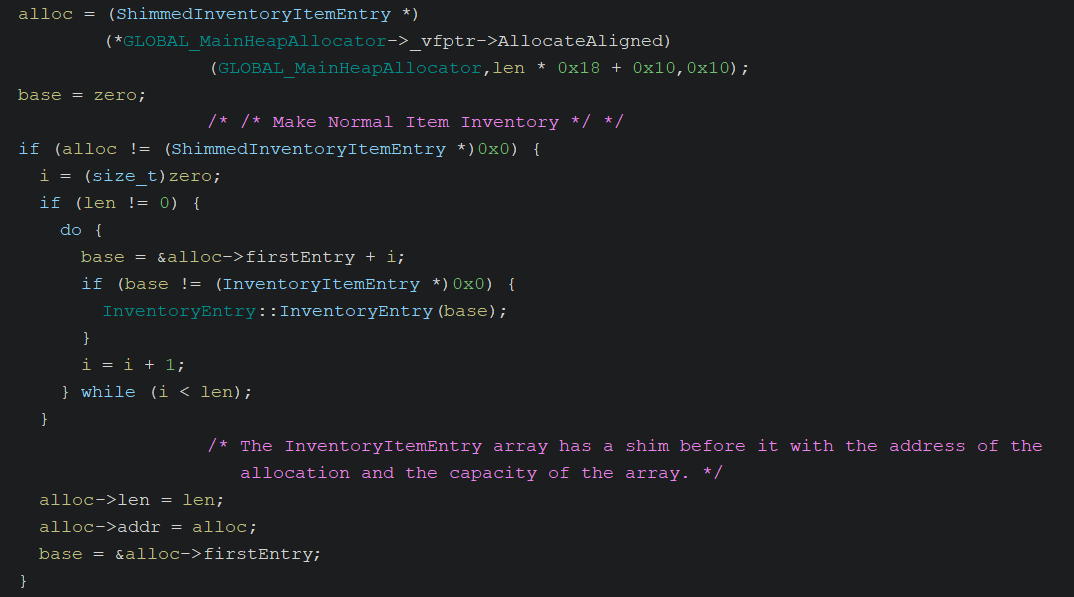
Here is a look at the pseudo code in Ghidra, cleaned up a little bit. I added a ShimmedInventoryItemData so that Ghidra would show a bit what I am talking about. Again, this is pseudo code, but, I honestly thought Ghidra was drunk, when I first saw this.
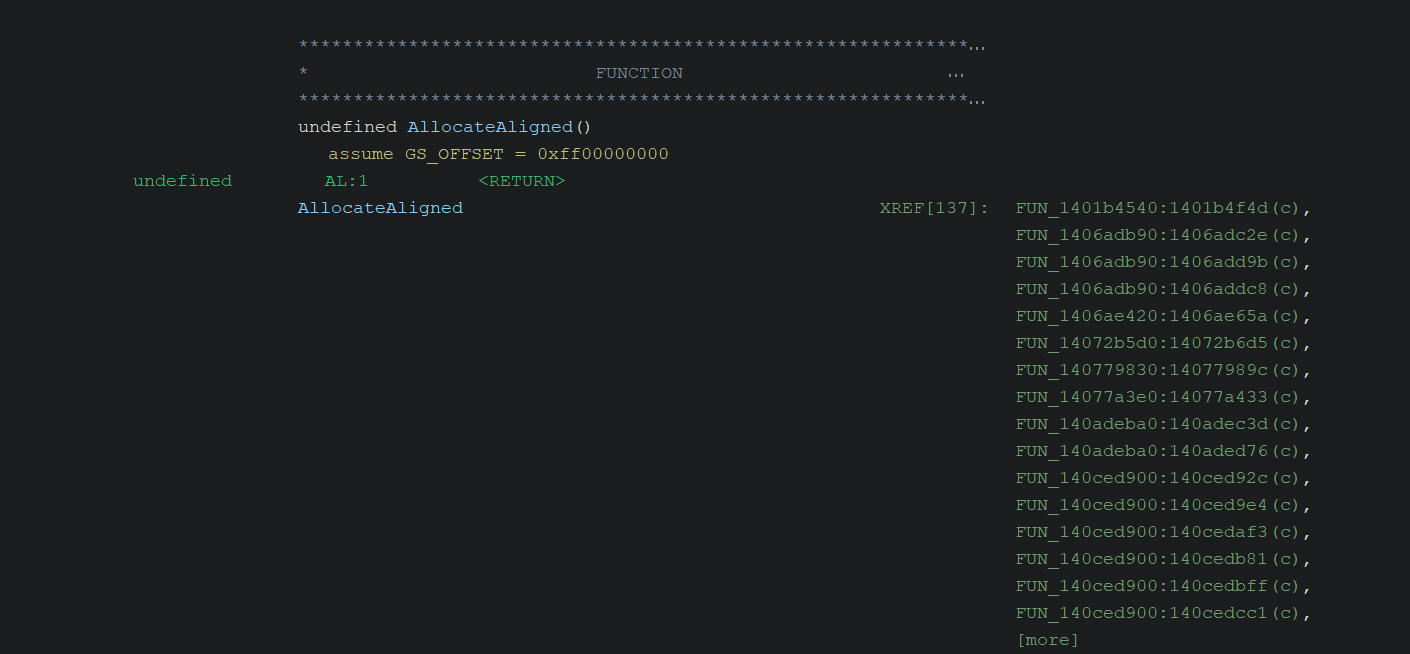
Turns out, this is not the only place they do this. I went and started looking at the references for this allocation function, of which Ghidra has detected 137 call sites.
In fact, as far as I can tell, every time they put this shim on their allocations, they end up making the same mistake. Here is another example from Elden Ring. I have no idea where this code is, I just found that it calls this allocator function and then make another condition that cannot fail.
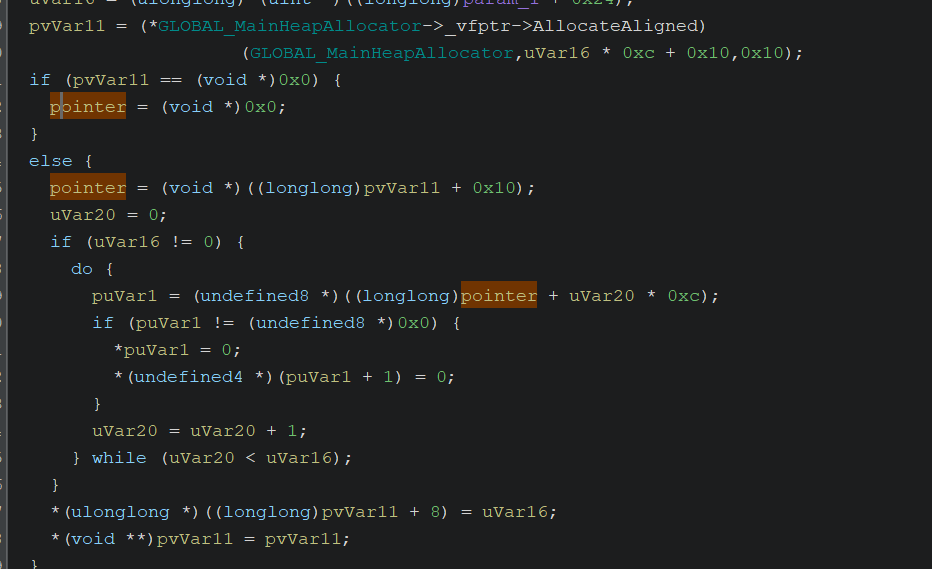
So, is FromSoft adding to their pointers manually, or do they have some kind of generic shim structure that they use, and they just don't understand how pointers work? Could there be some kind of abstraction that gets inlined by the compiler, that has this null check in it? That doesn't really make any sense. Regardless, the TEST instruction has to be generated by them checking if (&alloc->firstEntry == nullptr), which just isn't going to be null. You are essentially asking the compiler to add an offset when you reference fields further in than the base of the pointer. I am also surprised that MSVC didn't catch this? It's perfectly capable of doing so.
Conclusion
Okay, so, I explained my problem, but, do I have a solution? Theoretically. I think we could probably write some Ghidra scripts to check for this kind of thing by looking at all of the calls to this allocator, or even just every test instruction, and follow the registers involved backwards, to figure out if there's every a non-zero value being added to before being tested against itself. I think this could be a free win for those who are looking to make performance mods to make any of the souls games. Starting here would be great, and I will post the results if/when I get around to making a script to patch these unnecessary checks out. This might even be something that has been going on for a while, which I will update here shortly if I, or any of the other soulsmodders can find this behaviour in previous games. Maybe we could finally get blighttown above 10 FPS on a 4090.
Not sure what my next article here will be, but this will likely be more of a ranting place of things I find. Adobe next, maybe, because Premiere Pro has been crashing on me. :thinkus: If anyone knows a good wiki or doc type setup for me to start something to start making actual documentation on these systems for the souls games, and so that others can contribute, @ me on Twitter or something, idk.
Glossary
- Shim
Term for a piece of memory at the start of an allocation that holds information about said allocation. Usually hidden from the user of the memory by the allocator, as it's typically information for the allocator to use during cleanup.
- Bingus
Bald cat.